Tuesday morning I hopped on a supposedly express bus to Granada. Although it didn't seem particularly express it was only an hour drive to Granada which sits on the northwest of Lake Nicaragua. Granada is an old colonial city, one of the oldest in Central America, founded in 1524 by Francisco Hernandez de Córdoba. It was important for many reasons in colonial times, particularly for its location on the westernmost point of Lake Nicaragua. many countries sought to control the city and build a canal from Granada to the Pacific Coast, a relatively small distance. However, for that reason it was sacked and burned so many times that it's a wonder people didn't just give up on rebuilding it at some point. One of the more interesting stories of Granada being sacked and burned is when William Walker, an American adventurer, was asked by the Liberals that were based on Leon to come and help them oust the conservatives that were based in Granada. Walker came with 300 men that he is rounded up in the United States. He did so, but two years later he took over power of the Nicaraguan government and named himself the president of Nicaragua. However, this caused the Nicaraguan people to band together instead of be divided between the liberals and conservatives and they worked together to oust Walker from his presidency and from the country. Not too long afterwards Walker was caught in Honduras and then executed by a rifle squad.
There has been a lot of a lot of talk over the years about making a canal to the Pacific from Granada but the plans have always fallen through. Although currently the Nicaraguan government is apparently talking with China about the possibility of building this canal. Nicaraguans are quite divided about it. Some believe it would be a huge economic boost to the second poorest country in the Americas. However, many others express very valid concerns about the environmental degradation that could take place not only during the building of the canal but also from the transit of large ships up the Río San Juan (which would also have to be deepened) and across Lake Nicaragua. There are many towns and cities throughout the areas that would be affected that have "no al canal" (no to the canal) painted on walls.
I arrived in Granada and headed for the hostel I picked out. The first night that was only a dorm bed available which was definitely a little less than restful. Apparently I've outgrown the fun of dorm room sleeping and mainly just find it tedious. I switched to a private room for the next couple nights. The hostel was actually lovely, centered around a big courtyard filled with plants. They have comfy chairs and hammocks set around the communal areas and serve breakfast, lunch, and dinner, although the prices were a little high for the food.
I wandered around town a little and grabbed a late lunch and headed back to the hostel where I met Sam, who was originally from Boston but had fallen in love with an Algerian man while studying in Spain. They got married and had been living in Spain for the last 10 years. We chatted that evening and decided to do a tour the next day of Las Isletas, a series of 365 islands created when the Mombacho Volcano blew its top 20,000 years ago.
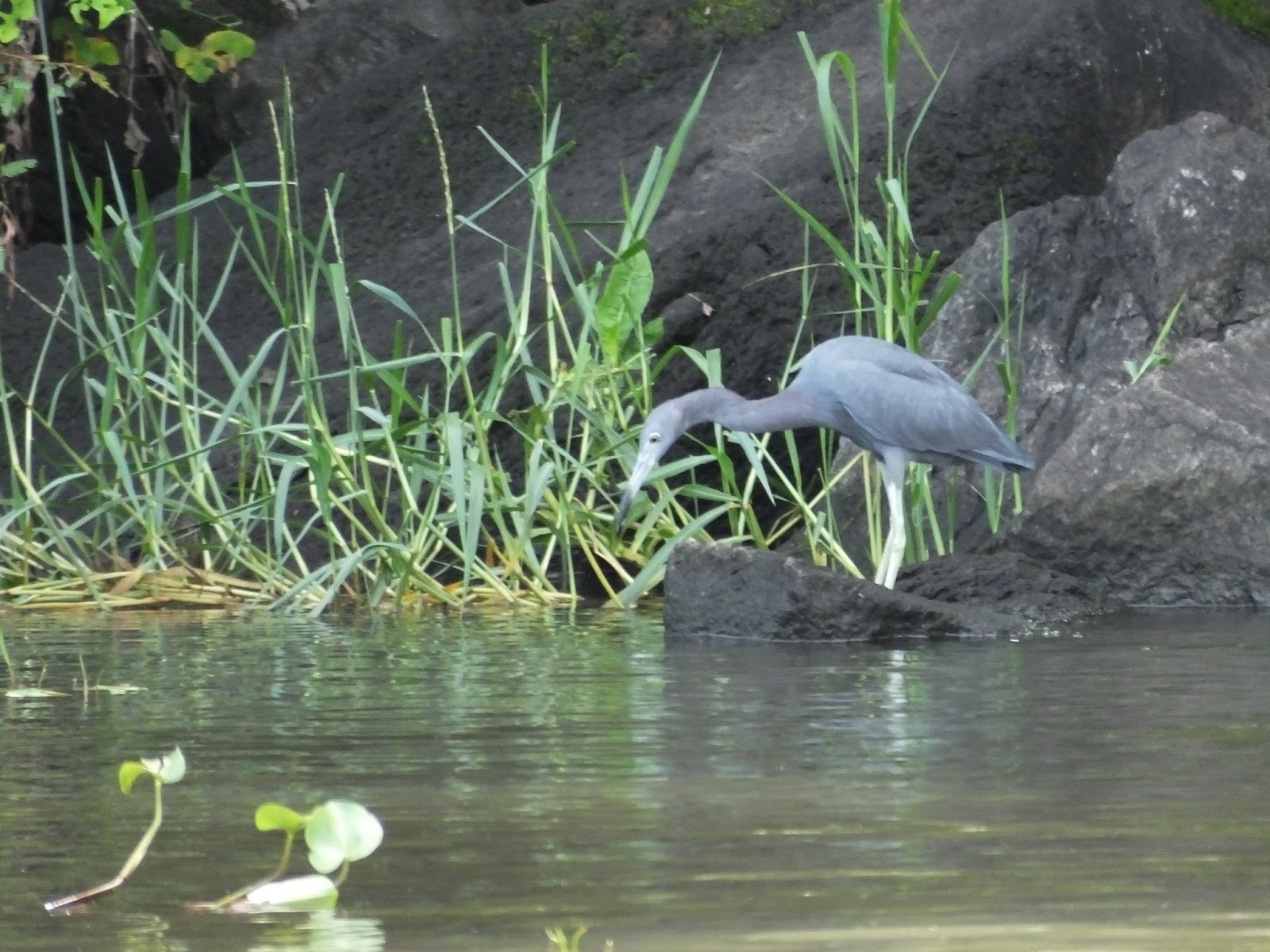
Next morning we were up early to meet the driver who took us down to the restaurant where the boats that do the tours are located. The whole area was set up with a bunch of restaurants and bars in the hope of driving tourists down to the waterfront with very little success, probably because the beach on the lake isn't particularly pretty. While, they say the water is clean it is certainly a little murky to say least. It's not the most inviting water I've seen. We hopped into the boat with our guide for the tour Lorenzo, who couldn't have been older than 20 or 21 at the most. We went out of a river covered with volcanic rocks in dense vegetation surrounding us. People waded in the water around us with nets for fishing that they throw out and haul in by hand. Women did laundry at the edges of the lake sitting on massive volcanic stones. There was even one rock wedge between the branches of a tree that had been placed there by dynamite that was used to widen the river at some point. We emerged from the river to be surrounded by small islands some undeveloped but others with million dollar houses owned by rich Nicaraguans and some foreigners as well. Lorenzo is a fountain of knowledge, not only about who owns what houses and how much they were worth, but also about the flora and fauna on the islands. The islands are made of huge boulders and the ones that were developed had beautiful rock walls filling in the gaps with docks made of rocks for the boats to pull up to. After zig-zagging through the islands for a while I was ready to buy one. There were a couple of undeveloped ones for sale for $160,000 US (anyone want to go in with me?)


About then Lorenzo asked Sam and I if we liked monkeys to which we answered yes, although we were a little confused by the question. He then took us to an island inhabited by five monkeys. There were a few other boats there as well. The monkeys were already down hanging from the trees. They were spider monkeys, Lorenzo told us, brought to the island by a veterinarian who wanted to see if they could swim. The howler monkeys that he'd brought could swim and quickly swam away from the small island lacking any sort of food whatsoever and with barely enough trees for cover. The spider monkeys did not swim and were now reliant on food from the tourist boats and when there were none the locals from the islands would feed them. There are Pancho and Lucia, the adults, and their offspring on Panchito and Lucero, who were born on the island. While they were faring okay on the island, the fifth monkey, a capuchin they called Michael Jackson, wasn't faring nearly so well. Apparently, when they had first been placed on the island he had a female partner. However, the spider monkeys harassed the other monkeys. They would chase them and hit them and wouldn't let them get to the food that was offered by tourists and locals alike. Eventually the female crawled into a little cave in the rocks and died of hunger. Michael Jackson, while still alive, was still being harassed by the spider monkeys and kept to himself. We only had a brief glance of him hiding in the trees away from the spider monkeys. Why all of the monkeys weren't taken off the island after the experiment I have no idea, nor did Lorenzo.
 |
| Lucia |
 |
| Lucero |
 |
| Pancho |
 |
| Panchito |
We headed to an island nearby after that where there were several little local restaurants where we could get a drink. Sam and I ordered coconut water out of real coconuts, one of the best things in the world. After a drink we back on the boat and on our way to the restaurant in which we started our tour. We joked when we got back and a dark green minivan with tinted windows was there to pick us up (not the car we arrived in) that it reminded us of all the times our parents had warned us as children not to get in the car with strangers. Luckily, our new driver took us to the café where we would have the lunch that was included in the price of the tour, which is always more expensive that you can get lunch by yourself.


 |
| Our guide Lorenzo. |


Afterwards we decided to wander around Granada for a bit and headed up to the bell tower in the cathedral in the Central Park where there were some decent views of town. Afterwards we sat at one of the little restaurants stationed at each corner of the park and tried to chat but were interrupted every few minutes by vendors trying to sell various things, pottery and hammocks, or wanting to sing a song, always the same song about light-eyed girls wearing sunglasses. I understand this is how people make their living but it can often be intrusive and some vendors are quite aggressive.


 |
| My new friend, Sam and the Mombacho Volcano in the background. |


Then there are the ones that just make you sad. The children that make animals, bugs, and flowers out of lengths of grass and sell them on the street. You see them during the day when they ought to be in school and in the middle of the night when they ought to be sleeping. It makes me wonder what could've happened in their lives that this is what they have to do every day. And they're are just so many of them. It's always in the cities and I wonder if they live on the street or if they do it to help support their families. Some of both I would guess. Not a happy ending to this but post something I feel is important to acknowledge and talk about.
